Productivity, Digital asset, and Asset exchange
Imagine that someone would like to buy your MacBook after you get the latest one. The only thing you can do is to list it on a marketplace and tell the buyer, “Hey, you should place an order for my listed MacBook at once so as not to be ordered by someone else.” or “I agree to sell my MacBook for $1000 to you, but I would list an auction. If someone bids a higher price, I’m sorry.”
It’s just how the NFT trade works nowadays. You can buy coffee in a bakery, sell something you designed on amazon, and bid on an antique vase in auctions, while the only way you can sell your NFT is on the marketplace.
However, should we buy NFT as a coffee, or should we sell NFT like selling real assets through sales? Even more, do we need NFT?
(For simplicity, we treat all commodities, goods, or assets as assets in the following context)
I. Do we need NFT
Before talking about NFT, we’ll start by discussing assets, digital assets, and crypto assets.
a. Productivity and assets
Asset is a significant concept for human progress to improve productivity. In ancient times, people hunted and farmed to get the energy they needed for living. People cooperate to make a sustainable life in a small group of people as some know how to have a good harvest, and some are good at setting a trap to hunt prey. People share the accrued value with the whole group by exchanging the crop or the meat by trust. As the population grows to 1000, people are not only working for survival but also for entertainment or some creative tools like hoes to improve farming productivity. Since the asset gets increasingly diverse, it gets harder and harder to make a deal between any two assets, which leads to the need for currency. With currency, the value of any asset can be turned into the same standard and circulate among all people adopting the currency. After the group expands to the country level, almost anything in demand is produced by someone in the group. However, due to the group’s scale, it’s hard to exchange assets with any stranger for fear of scams. It’s necessary to have an authority that guarantees the fairness of asset exchange.
From working alone for survival to forming a group and fulfilling each one’s talent. With the help of trust, currency, and efficient asset exchange, the productivity of all human beings can be maximized.
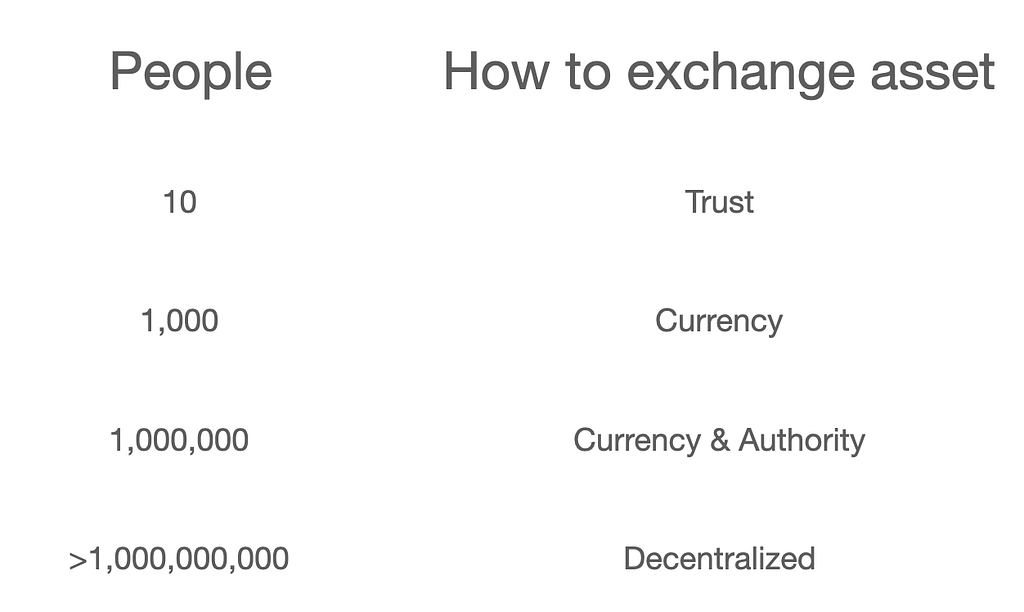
Asset exchange according to the scale of group.
b. Digital asset
Coming of age with the Internet, everyone on the earth is connected and can “exchange information” with anyone. You can send messages with your friend, write an essay to your paid subscribers or host a service providing online streaming. With the benefits of the Internet, an asset is not limited to the physical thing. Information can be a valuable asset and be exchanged more easily than physical. However, there would be some difficulty trading digital assets. Firstly, there is nothing to exchanging information through the Internet, which implies that scams exist in prevalence. There’s scarcely trust between any two strangers on the Internet. Then, there’s no common currency between any two people living in a different country. Lastly, a trusted authority is difficult to establish in the form of someone or some party worldwide.
The “inefficiency” of digital asset exchange would be a barrier to more productivity “real world” which is a combination of the physical and virtual world [1].

Value cycle.
c. Cryptocurrency and crypto asset
Before we discuss if cryptocurrency and crypto assets can make digital asset exchange more efficient and help people to achieve more productivity, we have to examine how information turns into a digital asset and how digital asset is exchanged.
The most significant difference between physical asset exchange and digital asset exchange is what you pay for is the ownership of the asset but not the asset itself in digital asset exchange. Concerning a physical asset, you own some meat, take it to the marketplace and turn over the meat to the buyer who pays you. In contrast, you cannot only send the digital art you build to the buyer but also the ownership certificate since the copy of “information” is relatively easy in digital form. Or you build an online streaming service; what you sell is not the video clip but the ownership of members or the access to the video.
You pay for the asset
'
s ownership but not the asset itself in digital asset exchange.
Is crypto technology the missing piece of the Internet? If crypto can motivate more productivity toward human beings by improving the efficiency of digital asset exchange and building trust, global currency, and trusted or even trustless authority in the digital world.
By adopting cryptocurrency in the digital asset exchange, the benefit would be there’s a global currency worldwide. In contrast, the trust and fairness of asset exchange are still not guaranteed. However, let's turn the digital asset into a crypto asset representing the ownership of digital art, the ownership of membership, or the access certificate to the online streaming service. We can rely on a trustless smart contract to guarantee the fairness of the exchange since the asset, and the currency are both on the blockchain. The asset exchange (transaction) is completed only if the seller receives the payment and the buyer gets the asset.
Take an online streaming service, for example; the service provider builds the service and turns the membership or access certificate ownership into a crypto token, which can be a fungible or non-fungible token. It is ensured that the buyers get the service access after paying, and the sellers capture the value they create. With the help of crypto technology, the improvement of asset exchange would encourage the asset builder to keep more and more productivity in return for the value they created. Nevertheless, can crypto guarantee the fairness of physical asset exchange?
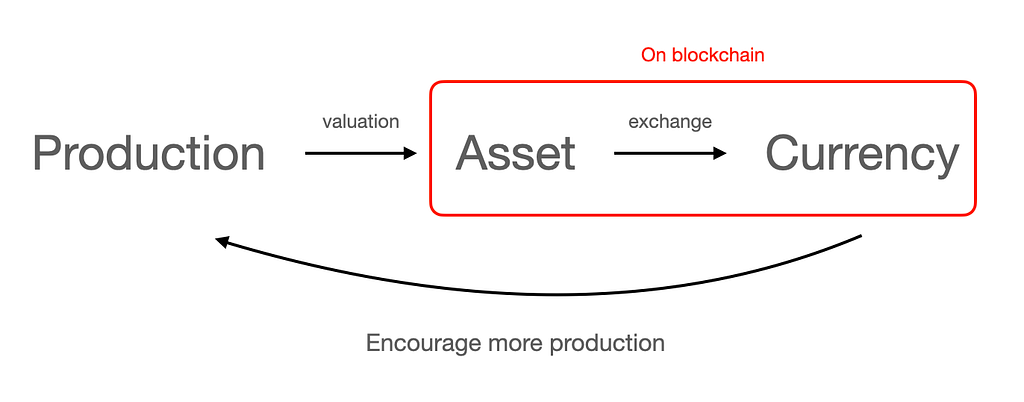
Value cycle with blockchain.
II. Asset exchange
Asset exchange can be classified in terms of what they exchange (physical or digital) and how they exchange (physically or virtually).
- Physical or digital assets in the physical world
When buying a coffee from a café, you pay by cash or card, even cryptocurrency, and get the coffee. Neither would you worry about the seller don’t give you what you buy after you pay, nor would the seller worry about you getting something without paying. The fairness of asset exchange can only be guaranteed by the law.
2. Physical asset in the digital world
For instance, if you order a book on Amazon, the trust between seller and buyer is by their trust toward amazon and the reputation system built in amazon.The higher the entity's score, the better the credibility. If the buyer or seller breaks the transaction's fairness, the violator would receive low credit and deter others from carrying out a transaction with them.
3. Digital assets in the digital world
A digital asset might be a piece of digital weapon equipment in the game, a membership, or an access certificate of some service. While physical asset exchange relies on trust between seller and buyer, an authority like government or law and reputation system like review record, it’s challenging to have such three elements during exchanging digital assets in the digital world, which means we need a trustless, self-regulated and reputation-based robust system to trade digital asset. Blockchain is a suitable technology with such features. A trustless network where the rule of asset exchange is encoded into a smart contract with a universal reputation record.
III. How to exchange crypto assets with smart contract
Once you would like to exchange assets in the market, you should specify which asset to sell and the expected price to receive. As you find someone to accept the order and exchange the asset with you, both seller and buyer would validate the order and exchange the asset. We’ll call the specification by seller or buyer order and divide the asset exchange process into order match, Order validation, and Asset transfer. Since all the exchange process occurs on smart contract, each protocol has different designs.
- Order match
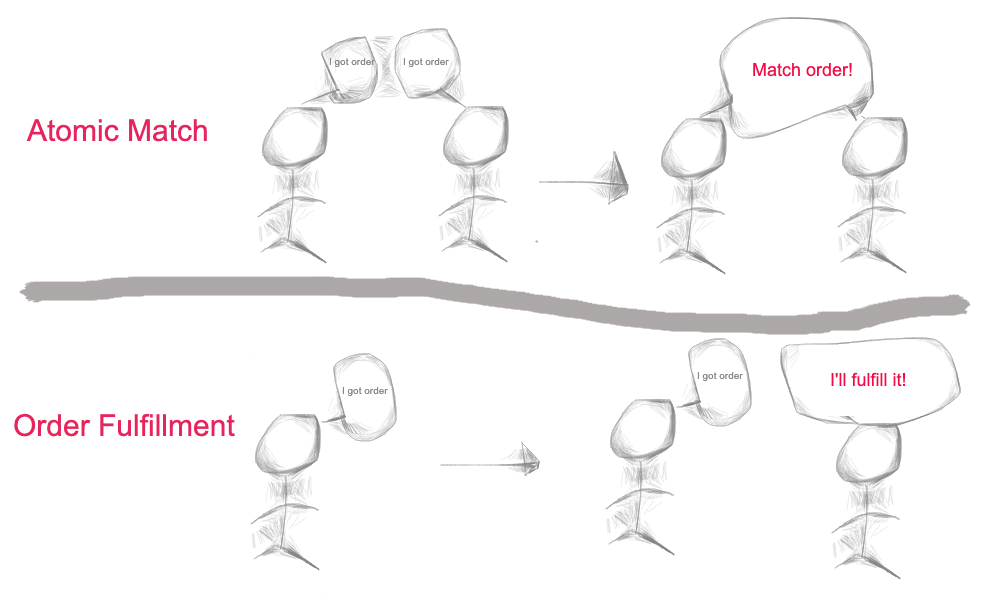
Order match can be realized in two ways,order atomic match_and_order fulfillment. In atomic match, the seller lists an order listing an asset to be sold and the expected price, while the buyer lists one with the requested asset and price willing to pay. Once the asset and price meet in two orders, the order match. In order fulfillment, the seller lists an order, including asset on sale and expected price, as the buyer accepts the order match. Wyvern protocol and Looksrare use atomic match; both seller and buyer have to make their order then match with smart contract. In contrast, Seaport and sudoswap are using a kind of order fulfillment. Only the seller or buyer makes their order; the other side fulfills the order requirement and gets the asset listed.
2. Order validation
Once the order match, the smart contract would verify the authentication and validity of orders. Firstly, the signature would be verified to ensure the order maker makes the order. Then, the validity of the order match is examined, including the price paid by the buyer meets the required price from the seller, the asset sold by the seller sent to the buyer while the buyer paid the price, the timestamp is valid, the order taker is the expected taker if specified, etc.
3. Asset transfer
After the order was verified, the asset sold by the seller was sent to the buyer if and only if the price by the buyer was transferred to the seller. Since all asset transfers were executed by contract, there must be an approved proxy to transfer assets from seller to buyer and the price paid from buyer to seller. The number of proxies varies by how each protocol transfers the asset; for instance, each user has their proxy in Wyvern protocol and must register the proxy before first use. In contrast to Wyvern, users can use the same proxy in the Seaport protocol.
Lastly, let’s discuss the consistent element between each protocol “how to not exchange assets.” In real life, if you don’t want to exchange assets with others, you can decline at any time before you make a deal and receive the payment. As the crypto asset exchange occurs on chain, all interactions with blockchain imply an irrevocable process. Anyone accessing the signature signed by the order maker can match the order. Among the protocols, users can cancel the order by specifying which order they signed is invalid on chain.
IV. How existing protocol works
Although the sequence of order validation and asset transfer depends on how the order match and the design principle of each protocol, almost all asset exchange is designed with the above three elements: order match, order validation, and asset transfer, we’ll discuss how Wyvern, ** Seaport**, ** Looksrare**, ** Sudoswap**works with such three aspects in the following posts of the “How NFT marketplace works“ series.
- Wyvern 2 (used by OpenSea before June 2022)
- Seaport
- Looksrarre
- Sudoswap
V. Conclusion
Recap.
- More efficient asset exchange higher productivity of all humans
- All digital assets should be crypto assets.
- Everyone has the right to choose how to sell their NFT
NFT should be traded not limited to a one-stop marketplace but in “all ways.” Everyone should decide to sell NFT point-to-point, in any community, or by delegating a sale. NFT should be sold anywhere by any means as a physical asset but in a decentralized way.
BOAT
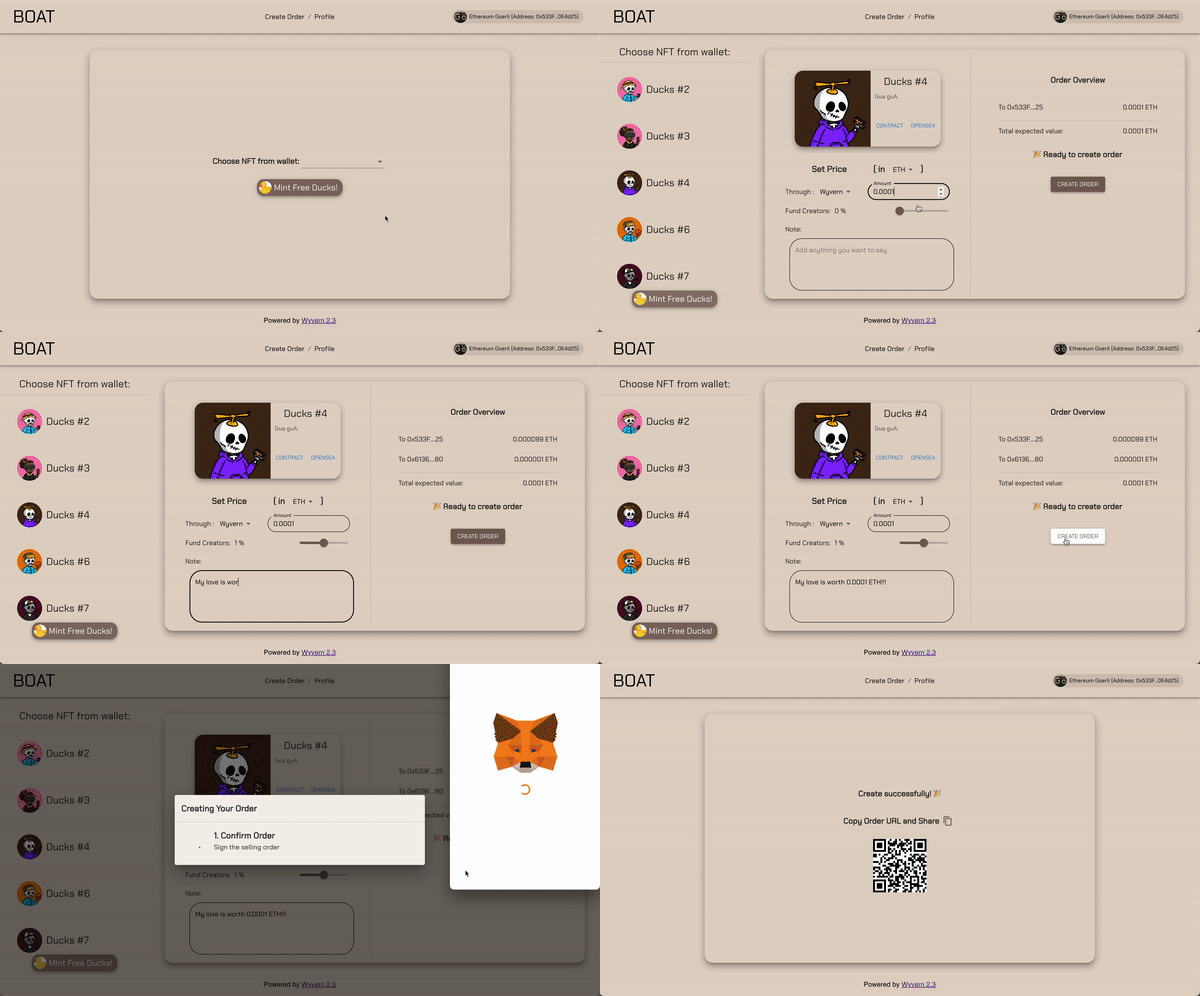
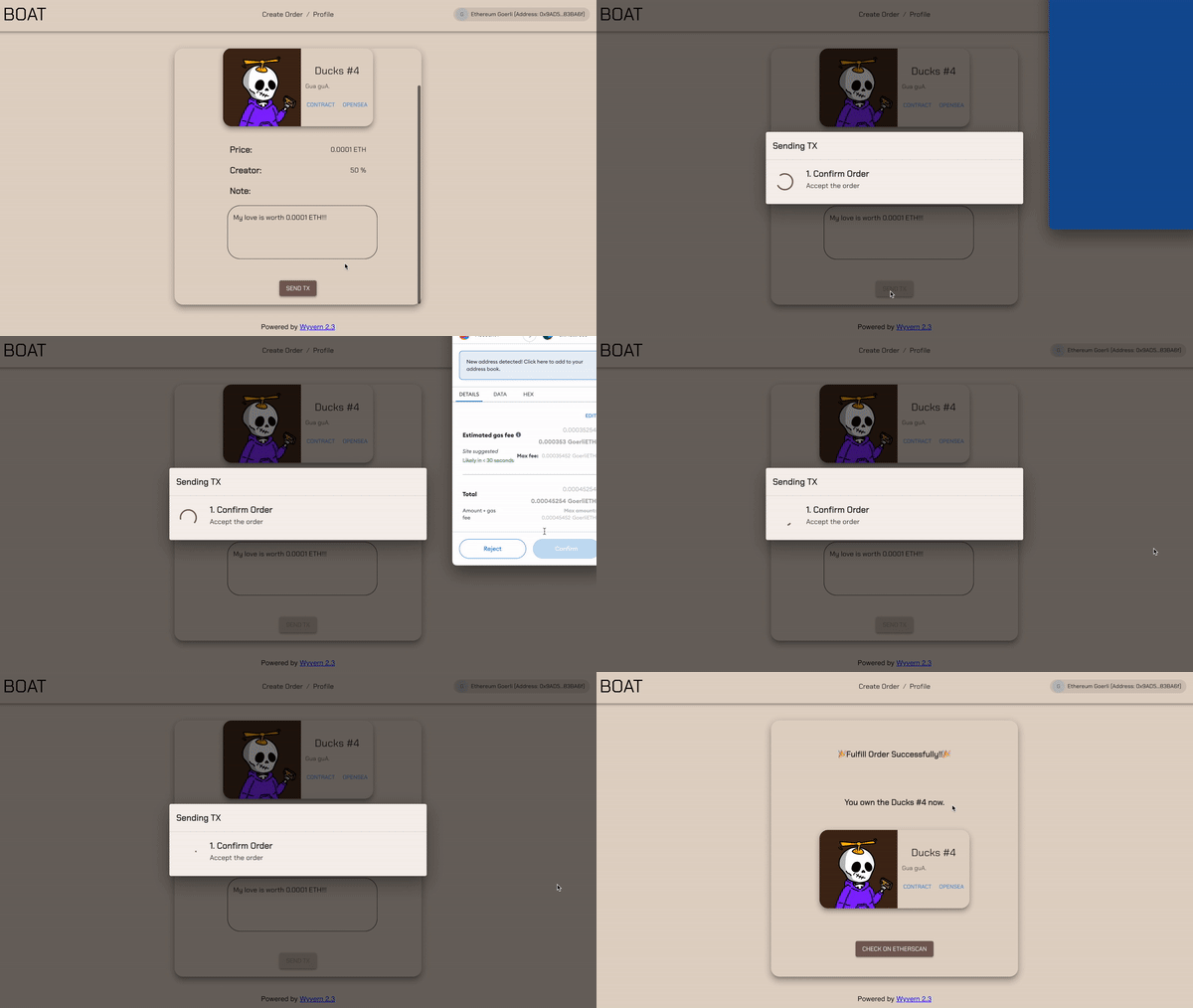
We build a service to make NFT trade easily in two steps.
You can choose what protocol to sell your NFT, how much fee you would like to set, and message to order taker.
- Seller creates order
2. Buyer takes order
If you are interested in BOAT, please join our discordfor more information. We are eager to hear any feedback from you!
Reference
[1] “Real world” is from Mark Zuckerburg in an interview with Lex Fridman